Going Solar in Florida: A Complete Homeowner's Guide
By Nespola Solar Solutions Team
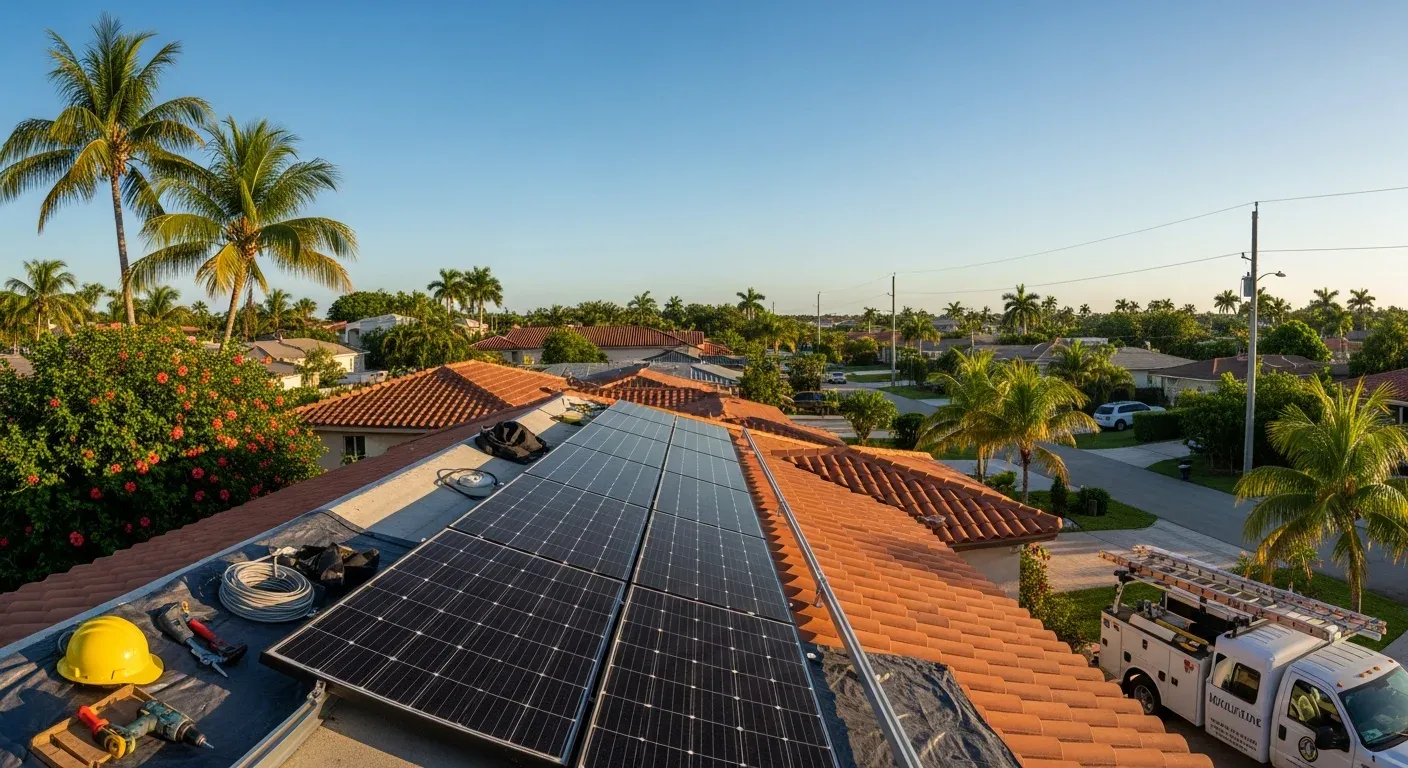
Florida is built for solar: high sun hours, high air-conditioning load, and statewide tax treatment that does not punish you for putting panels on the roof. It is also a state where storms, insurance, and changing net metering rules can turn a good quote into a bad one if nobody on your side is reading the fine print. This guide walks through the 2025 incentive stack, interconnection, hurricane-rated mounting, and how Nespola Solar Solutions shops installers for Florida homeowners.
Sales tax exemption
Florida exempts the sale of solar energy systems from state sales tax when the transaction qualifies under current Department of Revenue rules. On a $28,000–$40,000 system, that exemption is real money — often well over a thousand dollars compared with a taxable home improvement. Confirm that the exemption is applied on the contract, not “assumed” in a verbal pitch.
Property tax exemption
Florida also allows a property tax exemption for renewable energy source devices so the added value of the solar system is not piled onto your assessed value. Like Texas, this only helps if the paperwork is filed. We treat that filing as part of a complete install, not an optional afterthought.
Federal ITC at 30%
The federal residential credit remains 30% of qualified costs in 2025. Combined with the two Florida tax exemptions, the net capital cost of ownership is substantially lower than the headline install price. If you use a lease or PPA, the third-party owner typically takes the ITC; your “savings” are then entirely in the monthly payment versus the utility bill. That can still work, but it is a different product. We will say so plainly.
Net metering and NEM 3.0-style pressure
Florida’s investor-owned utilities have been in a multi-year fight over how exported solar is credited. “NEM 3.0” is the California nickname, but the same idea is spreading: move away from full retail-rate net metering toward a lower export credit, sometimes paired with time-of-use rates or extra fixed charges.
What that means for you in 2025:
- Ask which tariff you will be placed on after permission to operate (PTO).
- Model bill savings using that tariff, not last year’s retail rate.
- If export credits are weak, a right-sized system plus a battery may beat an oversized array that dumps cheap midday power to the grid.
Rules differ among FPL, Duke Energy Florida, Tampa Electric, and municipal utilities. Never let a statewide average substitute for your actual rate schedule.
Sun hours and production
Most of Florida sees roughly 4.5–5.5 average peak sun hours, with South Florida at the high end. That is enough for a well-oriented roof to offset a large share of a typical household’s usage, especially if you run AC much of the year. Production estimates should use PVWatts or equivalent weather files for your county, not a generic “Florida” multiplier.
Hurricane-rated mounting
This is non-negotiable. Arrays in Florida should be engineered to the applicable Florida Building Code wind loads for your exposure category and roof height, with documented attachment schedules, flashing that protects the roof warranty, and modules/racking with appropriate listings. After a named storm, insurance adjusters and HOAs will ask who stamped the plans.
If a quote is thousands cheaper because the racking is underspecified, that is not a discount. It is a future claim. We compare structural packages the same way we compare panel wattage.
Roof, insurance, and going solar together
Florida’s insurance market is tight. An aging roof under a new array is a problem: if you need to reroof in five years, panel removal and reinstall can wipe out years of savings. Nespola can bundle roof replacement, repair, or an insurance-claim path with the solar project so you are not coordinating two contractors in hurricane season.
Broker advantage in Florida
Florida is crowded with solar sales orgs. A broker’s job is to make them compete: equipment, wind engineering, workmanship warranty, production guarantee, and finance. You get a manager walkthrough and a side-by-side comparison instead of one high-pressure close. Call (215) 431-3330 or request a free estimate. Bring a recent FPL (or other utility) bill and a note on your roof age. That is enough to start a real design, not a brochure.
Ready to go solar? Call (215) 431-3330 or Get a Free Estimate →